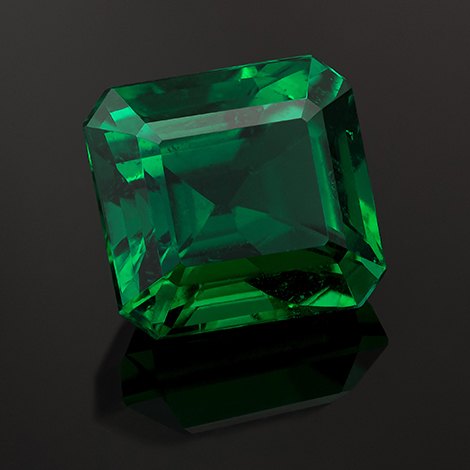
Emerald
- Hardness (Mohs)
- 7.5 to 8
- Refractive index
- 1.577 to 1.583 with birefringence from 0.005 to 0.009
- Specific gravity
- 2.67 to 2.84
Sizes and weights
Indicative weight of one stone
– carats
| Dimensions (mm) | Weight per stone (ct) |
|---|
Drag or use the arrow keys to turn the stone, Ctrl + wheel or + and − to zoom, Shift + drag or Shift + arrows to move about in the magnified stone, double-click or 0 to reset.
All shapes side by side
| Dimensions (mm) | Weight per stone (ct) |
|---|---|
| 2.00 | 0.03 |
| 2.50 | 0.06 |
| 3.00 | 0.10 |
| 3.50 | 0.16 |
| 4.00 | 0.24 |
| 4.50 | 0.31 |
| 5.00 | 0.45 |
| 5.50 | 0.60 |
| 6.00 | 0.77 |
| 7.00 | 1.10 |
| Dimensions (mm) | Weight per stone (ct) |
|---|---|
| 4 × 3 | 0.16 |
| 5 × 3 | 0.22 |
| 6 × 4 | 0.42 |
| 7 × 5 | 0.65 |
| 8 × 6 | 1.06 |
| 9 × 7 | 1.58 |
| 10 × 8 | 2.09 |
| 11 × 9 | 3.15 |
| Dimensions (mm) | Weight per stone (ct) |
|---|---|
| 4 × 2 | 0.08 |
| 5 × 2.5 | 0.12 |
| 6 × 3 | 0.22 |
| 8 × 4 | 0.49 |
| 10 × 5 | 0.88 |
| Dimensions (mm) | Weight per stone (ct) |
|---|---|
| 3.0 | 0.13 |
| 4.0 | 0.31 |
| 4.5 | 0.33 |
| 5.0 | 0.43 |
| 5.5 | 0.56 |
| 6.0 | 0.92 |
| 7.0 | 1.16 |
| 8.0 | 1.48 |
| 9.0 | 2.1 |
| Dimensions (mm) | Weight per stone (ct) |
|---|---|
| 4 × 3 | 0.18 |
| 5 × 3 | 0.25 |
| 6 × 4 | 0.50 |
| 7 × 5 | 0.92 |
| 8 × 6 | 1.38 |
| 9 × 7 | 1.93 |
| 10 × 8 | 3.16 |
| 11 × 9 | 4.09 |
| Dimensions (mm) | Weight per stone (ct) |
|---|---|
| 5 × 3 | 0.17 |
| 6 × 4 | 0.35 |
| 7 × 5 | 0.60 |
| 8 × 5 | 0.77 |
| 9 × 6 | 1.23 |
| Dimensions (mm) | Weight per stone (ct) |
|---|---|
| 2.0 | 0.06 |
| 2.5 | 0.09 |
| 3.0 | 0.14 |
| 3.5 | 0.28 |
| 4.0 | 0.33 |
| 4.5 | 0.46 |
| 5.0 | 0.61 |
| 5.5 | 0.65 |
| 6.0 | 0.99 |
| 7.0 | 1.59 |
Sources
The main desposits (but also the most famous) are in Colombia, but beautiful emeralds can also be found in other countries
such as Zambia, Brazil, Zimbabwe, Madagascar, Pakistan, India, Afghanistan and Russia.
Common treatments
The most common treatment is fracture-filling:
– using oil such as cedar oil or sweet almond oil, waxes or colorless resins
– using coloured oils to enhance the gemstone colour (coloured filler materials can also be considered as dyes as it changes the gem colour)
– using synthetic resin such as epoxy
Fracture-filling improves the apparent clarity of a gemstone by making its fractures less visible
Most laboratories provide informations on the amount of filler material present in the gemstone (minor, moderate, major).
However few will confirm the type of filling material (such as the French Laboratory of Gemmology (LFG), and Gem Paris).
Care and cleaning
Emeralds can break easily and should not be exposed to mechanical shocks.
Keep away from solvents that may interfere with the filler materials,
but also heat that could make included stones break or dry their filler out.
You should also avoid detergents, ultrasound and steam jets for same reason.