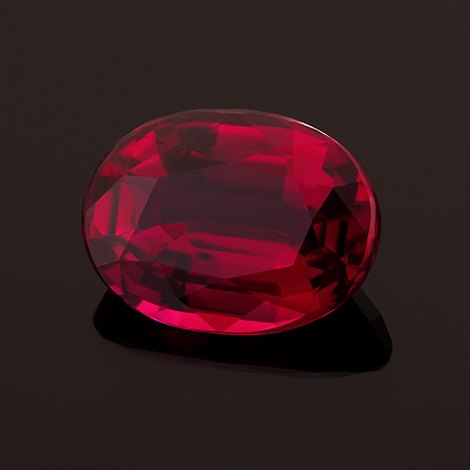
Ruby
- Hardness (Mohs)
- 9
- Refractive index
- 1.762 to 1.774 with birefringence from 0.005 to 0.009
- Specific gravity
- 4
Sizes and weights
Indicative weight of one stone
– carats
| Dimensions (mm) | Weight per stone (ct) |
|---|
Drag or use the arrow keys to turn the stone, Ctrl + wheel or + and − to zoom, Shift + drag or Shift + arrows to move about in the magnified stone, double-click or 0 to reset.
All shapes side by side
| Dimensions (mm) | Weight per stone (ct) |
|---|---|
| 2.0 | 0.05 |
| 2.5 | 0.09 |
| 3.0 | 0.15 |
| 3.5 | 0.21 |
| 4.0 | 0.38 |
| 4.5 | 0.45 |
| 5.0 | 0.66 |
| 5.5 | 0.85 |
| 6.0 | 1.10 |
| 7.0 | 2.11 |
| Dimensions (mm) | Weight per stone (ct) |
|---|---|
| 4 × 3 | 0.20 |
| 5 × 3 | 0.30 |
| 6 × 4 | 0.62 |
| 7 × 5 | 1.06 |
| 8 × 6 | 1.57 |
| 9 × 7 | 2.37 |
| Dimensions (mm) | Weight per stone (ct) |
|---|---|
| 4 × 2 | 0.12 |
| 5 × 2.5 | 0.23 |
| 6 × 3 | 0.35 |
| 8 × 4 | 0.77 |
| 10 × 5 | 1.48 |
| 12 × 6 | 2.23 |
| Dimensions (mm) | Weight per stone (ct) |
|---|---|
| 3.0 | 0.12 |
| 4.0 | 0.27 |
| 4.5 | 0.48 |
| 5.0 | 0.59 |
| 5.5 | 0.83 |
| 6.0 | 0.98 |
| 7.0 | 1.58 |
| 8.0 | 2.25 |
| 9.0 | 3.09 |
| 10.0 | 4.60 |
| Dimensions (mm) | Weight per stone (ct) |
|---|---|
| 4 × 3 | 0.27 |
| 5 × 3 | 0.36 |
| 6 × 4 | 0.45 |
| 7 × 5 | 1.51 |
| 8 × 6 | 2.22 |
| 9 × 7 | 3.22 |
| Dimensions (mm) | Weight per stone (ct) |
|---|---|
| 5 × 3 | 0.26 |
| 6 × 4 | 0.51 |
| 7 × 5 | 0.89 |
| 8 × 5 | 1.13 |
| 9 × 6 | 1.81 |
| 10 × 7 | 2.46 |
| Dimensions (mm) | Weight per stone (ct) |
|---|---|
| 2.0 | 0.06 |
| 2.5 | 0.11 |
| 3.0 | 0.21 |
| 3.5 | 0.29 |
| 4.0 | 0.44 |
| 4.5 | 0.68 |
| 5.0 | 0.80 |
| 5.5 | 0.97 |
| 6.0 | 1.43 |
| 7.0 | 2.34 |
Sources
Main deposits are Burma and Mozambique, but rubies can also be found in Tanzania, Kenya, Madagascar, Thailand...
Common treatments
– Heat treatment: using high temperature to enhance the color. It is the most common treatment
– Filling cracks and fractures: with colourless or coloured oil, with melted glass (glass-filling) or with lead-base glass (lead glass-filling)
– “surface diffusion” and bulk diffusion (also called lattice diffusion) during heat-treatment:
using colouring agents, and Beryllium for lattice diffusion, to change or enhance a gemstone’s colour.
Most laboratories disclose the presence of heat treatments and fillings as well as the degree of treatment.
A few will also confirm the most sought after colour, "pigeon blood red".
The SSEF and Gübelin laboratories now agree on a common definition for Pigeon Blood rubies:
the gem must be unheated, with an extremely bright and very even colour, as well as a very high clarity.
The colour should be a deep red without any blueish or brownish tints.
The ruby must also have a strong fluorescence, which explains why these laboratories say that Pigeon Blood rubies are mostly of Burmese origin.
Care and cleaning
Corundum is a very hard material. However, it may scratch.
Handle with care and store separately to avoid any risk of abrasion.
Corundums do not cleave and are therefore more resistant than most gemstones in the jewellery business.
Clean with warm soapy water and dry with a soft cloth.