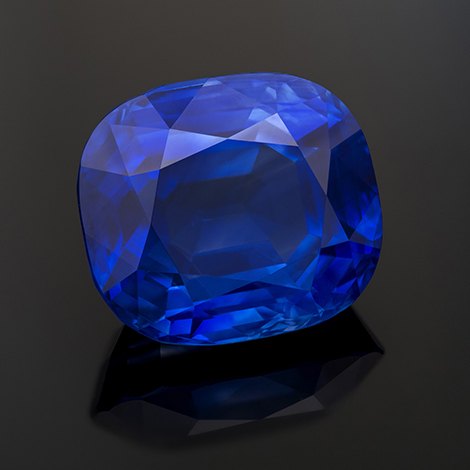
Sapphire
- Hardness (Mohs)
- 9
- Refractive index
- 1.76 to 1.780, birefringence from 0.008 to 0.009
- Specific gravity
- 4
Sizes and weights
Indicative weight of one stone
– carats
| Dimensions (mm) | Weight per stone (ct) |
|---|
Drag or use the arrow keys to turn the stone, Ctrl + wheel or + and − to zoom, Shift + drag or Shift + arrows to move about in the magnified stone, double-click or 0 to reset.
All shapes side by side
| Dimensions (mm) | Weight per stone (ct) |
|---|---|
| 2.0 | 0.05 |
| 2.5 | 0.09 |
| 3.0 | 0.15 |
| 3.5 | 0.21 |
| 4.0 | 0.38 |
| 4.5 | 0.45 |
| 5.0 | 0.66 |
| 5.5 | 0.85 |
| 6.0 | 1.10 |
| 7.0 | 2.11 |
| Dimensions (mm) | Weight per stone (ct) |
|---|---|
| 4 × 3 | 0.20 |
| 5 × 3 | 0.30 |
| 6 × 4 | 0.62 |
| 7 × 5 | 1.06 |
| 8 × 6 | 1.57 |
| 9 × 7 | 2.37 |
| Dimensions (mm) | Weight per stone (ct) |
|---|---|
| 4 × 2 | 0.12 |
| 5 × 2.5 | 0.23 |
| 6 × 3 | 0.35 |
| 8 × 4 | 0.77 |
| 10 × 5 | 1.48 |
| 12 × 6 | 2.23 |
| Dimensions (mm) | Weight per stone (ct) |
|---|---|
| 3.0 | 0.12 |
| 4.0 | 0.27 |
| 4.5 | 0.48 |
| 5.0 | 0.59 |
| 5.5 | 0.83 |
| 6.0 | 0.98 |
| 7.0 | 1.58 |
| 8.0 | 2.25 |
| 9.0 | 3.09 |
| 10.0 | 4.60 |
| Dimensions (mm) | Weight per stone (ct) |
|---|---|
| 4 × 3 | 0.27 |
| 5 × 3 | 0.36 |
| 6 × 4 | 0.45 |
| 7 × 5 | 1.51 |
| 8 × 6 | 2.22 |
| 9 × 7 | 3.22 |
| Dimensions (mm) | Weight per stone (ct) |
|---|---|
| 5 × 3 | 0.26 |
| 6 × 4 | 0.51 |
| 7 × 5 | 0.89 |
| 8 × 5 | 1.13 |
| 9 × 6 | 1.81 |
| 10 × 7 | 2.46 |
| Dimensions (mm) | Weight per stone (ct) |
|---|---|
| 2.0 | 0.06 |
| 2.5 | 0.11 |
| 3.0 | 0.21 |
| 3.5 | 0.29 |
| 4.0 | 0.44 |
| 4.5 | 0.68 |
| 5.0 | 0.80 |
| 5.5 | 0.97 |
| 6.0 | 1.43 |
| 7.0 | 2.34 |
Sources
Sapphire deposits can be found in many countries. For instance in Madagascar, Sri Lanka and Burma but also in India, Thailand, Australia, Africa...
Common treatments
– Heat treatment: using high temperature to enhance the color. It is the most common treatment
– Filling cracks and fractures with oil or resin and sometimes with glass (glass-filling) or lead-base glass (lead glass-filling)
– “surface diffusion” using colouring agents, during heat treatment, to change or enhance a sapphire’s colour
– bulk diffusion (also called lattice diffusion), during heat-treatment, for pink sapphires:
using colouring agents and Beryllium to change the gemstone’s colour.
The resulting pinkish orange colour makes the gem look like a padparadscha sapphire.
– Irradiation of very pale yellow sapphires to deepen their colours.
The resulting color is not stable and fades upon exposure to light.
Most laboratories disclose the presence of heat treatments and fillings, as well as the amount of filling material or the degree of thermal enhancement.
A small number will confirm the colour: the SSEF and Gübelin laboratories have jointly agreed on a definition of Royal Blue sapphires:
unheated gems with a very even, bright and saturated colour, no greyish or greenish tints.
A sapphire with a tinge of purple could still be called a royal blue.
Historically, the only deposits for “royal blue” sapphires were in Myanmar (Burma).
But nowadays, sapphires from Sri Lanka or Madagascar can also be called “royal blue”.
Care and cleaning
Sapphire is a very hard material. However, it may scratch.
Handle with care and store separately to avoid any risk of abrasion.
Corundums do not cleave and are therefore more resistant than most gemstones in the jewellery business. Clean with warm soapy water and dry with a soft cloth.